
Mediazione Creditizia — OAM 2014-A
What a Custom Refillable Fragrance Programme Costs a New Brand
A custom refillable programme is not one purchase. It is a development fee, a tooling bill, a first production run and a validation exercise, and each block is invoiced at a different moment for a different reason. New brands typically budget for the production run and are surprised by the other three. Knowing the sequence in advance is what turns a frightening total into a plan.
Key takeaways
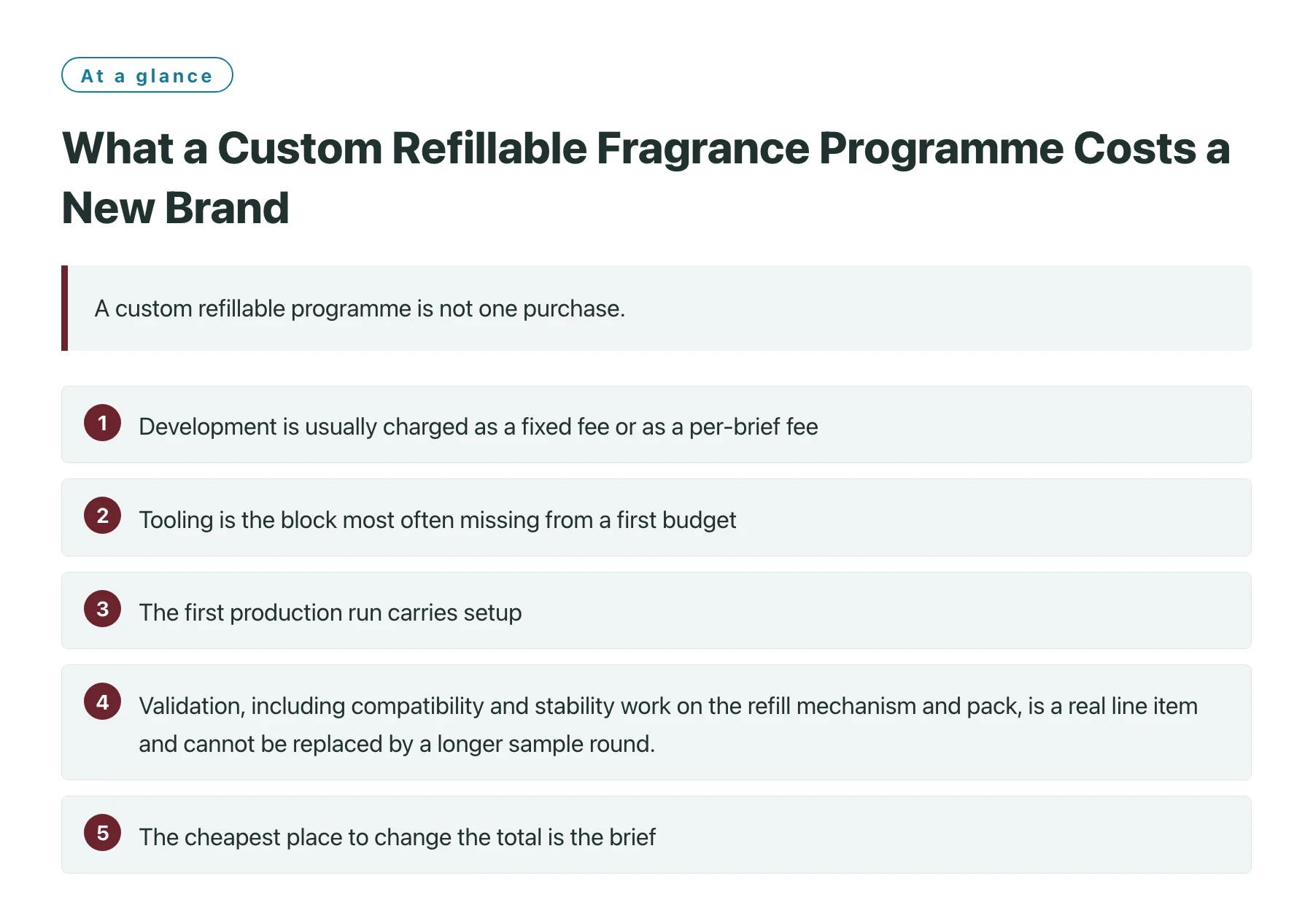
- Development is usually charged as a fixed fee or as a per-brief fee, and it buys formulation time and sample rounds rather than a guaranteed formula.
- Tooling is the block most often missing from a first budget, because a refillable format needs moulds for the vessel and the reservoir before anything can be filled.
- The first production run carries setup, line clearance and minimum batch costs that later runs spread across more units.
- Validation, including compatibility and stability work on the refill mechanism and pack, is a real line item and cannot be replaced by a longer sample round.
- The cheapest place to change the total is the brief, because interface, fill volume and decoration are all fixed before tooling is cut.
New brands often arrive with a single number in mind, usually derived from the retail price of a finished product. That number describes a purchase, not a programme, and the difference is where most first budgets come apart.
It helps to separate what is paid once from what is paid per unit. A development fee and a tooling bill happen once; the fill, the pack and the freight happen every time. A refillable format adds a step to the second category, because the reservoir has to be filled, closed and tested as its own product.
The sequence below is the order in which a custom refillable programme is normally invoiced. It applies to a one-person brand and to an established company alike; the only thing that changes with size is how many blocks run in parallel.
Four blocks, in the order they are invoiced
- Development and samplingThe brief is turned into candidate formulas, and the brand pays for perfumery time and a set number of sample rounds rather than for a result.
- Tooling and component approvalMoulds, decoration tooling and the refill interface are produced, and the brand approves physical components rather than drawings.
- Validation on the finished systemCompatibility between the fragrance and the pack, seal behaviour and storage stability are checked while the system is still changeable.
- First production runBulk, filling, assembly, label control and pack-out are billed together, with setup and minimum-batch costs concentrated in this run.
- Repeat runsLater orders repeat the fourth block without the first three, which is why the second order is usually the one that shows a brand its true unit cost.
Where the money goes in a refillable custom programme
| Budget block | What it pays for | What changes the number |
|---|---|---|
| Development | Perfumery time, trial formulas, sample rounds | How specific the brief is and how many directions are tested |
| Vessel tooling | Moulds, decoration tooling, first-article approval | Whether the pack is exclusive or a shared mould |
| Refill interface | Mechanism parts, seal development, fit trials | How many moving parts the consumer has to handle |
| Validation | Compatibility, seal and stability work on the system | Target markets, storage claims and shelf-life ambition |
| First run | Bulk, filling, assembly, labelling, pack-out | Batch size, fill tolerance and packing configuration |
A supplier that will not separate these five lines is not hiding anything necessarily, but the brand cannot manage a budget it cannot see.
Two decisions that decide whether the programme stays affordable
Within a fixed budget, the two decisions with the largest effect are the interface and the exclusivity of the pack. Both are taken early, and both are expensive to revisit.
Exclusive tooling or a shared platform
A bespoke vessel is the most visible way to look different, and the most expensive way to start. Sharing a mould platform and differentiating through colour, decoration and the refill identity keeps the tooling block small enough to survive a slow first year.
This is a question worth putting to the partner directly rather than assuming. A custom programme handed to a factory that turns a brief into a scent usually comes with a view on which parts are worth making exclusive and which are not.
How much of the work one partner takes on
Every handover between suppliers is a place where a specification can drift, and drift is paid for twice. Bringing formula, filling and pack under one scope, as described under custom fragrance R&D and production, removes some of that risk but concentrates it in one relationship.
The trade-off is real in both directions. A brand with a designer, a packaging agent and a filling partner already in place may lose more by consolidating than it gains. A brand with no team at all usually gains more than it loses.
Experience is a reasonable proxy for how many of these handovers a supplier has already seen. Xuelei's history is public, and a manufacturer that has run similar formats before tends to ask fewer of the questions that cost a first-timer a sample round.
Before committing, it also pays to look at Xuelei and ask which of them resembles your format, rather than which of them looks most impressive.
One cost that arrives late if the brief is vague
Reformulation is the block nobody budgets for until it happens. If a formula leans on materials with use restrictions, a market entry or a labelling decision can force a change after the scent has been approved, and that change touches the sample round, the validation work and sometimes the label artwork [1].
The mitigation is front-loading the market question: where will this product be sold, and does the brief already account for the restrictions that apply there.
Sources
- IFRA Standards Library (International Fragrance Association) —— The IFRA Standards Library lists the restrictions the fragrance industry applies to individual fragrance ingredients, based on safety assessments; it is the reference point for compliant fragrance formulation.
Frequently asked questions
Should a new brand expect to pay a development fee?
Yes, in most custom programmes. Formulation time is work, and a supplier that offers free development is usually recovering it in the unit price or limiting the brand to a smaller library of directions. Ask what the fee includes and how many rounds it covers.
Can tooling be avoided entirely on a refillable format?
Only by using an existing pack and mechanism platform. That is a legitimate and often sensible first step. It limits how distinctive the vessel can be, but it removes the largest one-off cost from the first order.
Why is the second order cheaper than the first?
Because development, tooling and validation do not repeat. The second order pays for bulk, filling, assembly and freight, which is the part that scales. Comparing a first-run quote with a repeat-run quote is a fair way to see the real unit cost.
How long should validation take on a refillable system?
Long enough to test repeated opening and closing, seal behaviour and storage of the filled refill. The exact duration depends on the pack and the materials, and it is worth agreeing the test plan before tooling rather than after.
Pronto a confrontare la tua rata?
Oltre 1.200.000 preventivi erogati dal 2007. Compila il modulo e un consulente OAM ti ricontatterà entro 24 ore lavorative.
Richiedi un preventivo gratuito